Pages

Monday, 10 January 2022

A few of the birds we see during the winter months.

 It is ages since I posted on my bird blog, but here are a few recent photos from the garden during December and the start of January.  I still have October and November to go through!!!!

European robin (Erithacus rubecula).

House sparrow (Passer domesticus), female.

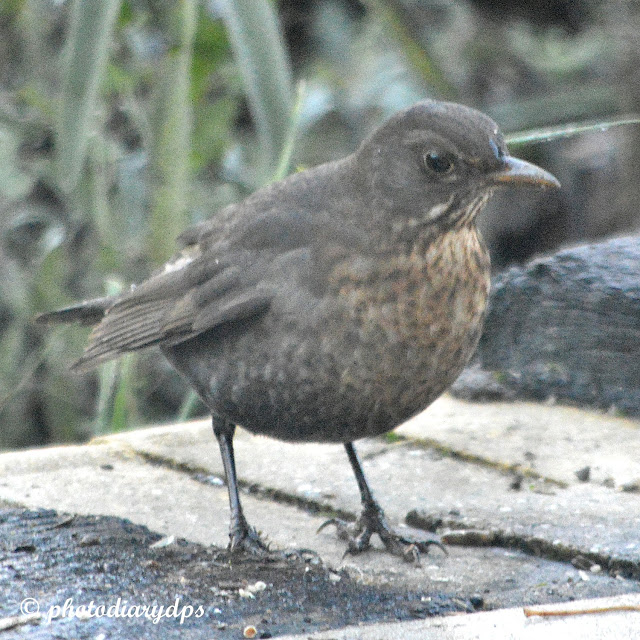
Common blackbird (Turdus merula) one of the young birds...
As above.

Eurasian blue tit (Cyanistes caeruleus) on the windowsill.

As above.

As above.

Great tit (Parus major).

Eurasian sparrowhawk (Accipiter nisus).

European robin (Erithacus rubecula)...

As above...

As above.

Eurasian Nuthatch or Wood Nuthatch (Sitta europaea).

Eurasian blue tit (Cyanistes caeruleus)...

As above.

Great excitement here yesterday morning, I glanced out of the window and commented that the bird on the step did not look familiar, I grabbed the camera and took 4 quick photos through the window and it was gone. Did a bit of research and came up with Cirl Bunting, a first so far as we know in the garden, and certainly a first for both of us.
Cirl bunting (Emberiza cirlus)...

As above...

As above...

As above.

I had a fall at the end of November and damaged my Tamron lens. I am still waiting for the spare part (staff shortage so I am told) so all these photos were taken with my old camera the Nikon D3200 with the
55 -300mm telephoto lens. This old lens just will not work on my new D3500 camera!


See also my Photodairy with lots of flowers and insects.

Tuesday, 23 November 2021

23/11/2021 A few more photos from South Africa

 My thanks once again to Christelle for these photos.  I have so many photos of my own to catch up with, but it is taking so much time trying to find the ID's of many.

This little fellow flew inside the house, when Christelle caught it to take it outside, it was in no hurry to leave her hand.
Southern double-collared sunbird or lesser double-collared sunbird (Cinnyris chalybeus)...

As above...

As above.

A rare sighting of a European Oystercatcher (Haematopus ostralegus), they breed in the Palaearctic region and winter south to the coasts of Africa. Not just a rare sighting but also this one only has one leg...  Seen in the Eastern Cape. 

As above...

As above, plus a gull...

As above...

As above...

As above...

As above but keeping company with some African Black Oystercatchers (Haematopus moquini).


See also my Photodairy with lots of flowers and insects.


Monday, 1 November 2021

01/11/2021 Christelle's trip to Addo National Park, Eastern Cape, South Africa

 I have masses of photos from my last two trips to bird national parks here in France but I still have not had time to go through them all and work out IDs.  My thanks again to Christelle for taking these photos and sending them to me with all the details that I require.

Bokmakierie (Telophorus zeylonus)  A bushshrike.

As above.

Cape Longclaw (Macronyx capensis). You can see the longclaws clearly in this photo...

As above...

As above.

Rufous-naped lark (Mirafra africana)...

As above


See also my Photodairy with lots of flowers and insects.

Sunday, 17 October 2021

08/10/2021 Réserve Ornithologique du Teich.

Apologies (yet again) for the lack of posts, but the garden and kitchen have been very demanding. Now the weather is cooling down, I will have more time to try and go through the many photos that I have taken over the past couple of months. These photos (and many more), were taken on a recent trip to Arcachon which is below Bordeaux and about 3 1/2 hours from home

The Eurasian Spoonbill (Platalea leucorodia) is a large wading bird 80 to 90 cm in length, and an adult weight of 1.7 to 2 kg. It's characteristic long, black, spoon-shaped beak makes it easy to identify, differentiating it from all other large European wading birds.

Its plumage is completely white, with black legs. Juveniles, very similar in appearance to adults, can be distinguished by the black tips on their flight feathers.

Spoonbills are typically dependent on wetlands and preferentially use freshwater marshes or the lagoons and estuaries just behind the coastal strip.

Present in western Europe, where it nests from the spring onward in Spain, France, the Netherlands, and Belgium, it migrates in the autumn to overwinter mainly in the south of Spain, and in northern, eastern or western Africa.

Individuals ringed in the Camargue have already been spotted in South Sudan, testifying to spoonbills’ long-distance migration capacities

The species is considered as vulnerable in France, and classified as such (VU) in the IUCN Red List.


My thanks for the above information which is taken from


See also my Photodairy with lots of flowers and insects.

Joining up with

 Wild Bird Wednesday

I'd Rather B Birdin'

and

My Corner of the World

Sunday, 19 September 2021

Melodious Warbler

I apologise for not blogging much, but the vegetables in the garden, and the fruit on the trees, are stealing all my spare time while I preserve the overflow ready for winter when the garden is basically bare.  Here are a few photos I took while picking blackberries and I realised I had company.   I have lots of photos to go through, not only my own, but from Christelle in South Africa as well


The Melodious Warbler (Hippolais polyglotta).


See also my Photodairy with lots of flowers and insects.

Joining up with

 Wild Bird Wednesday

I'd Rather B Birdin'

and

My Corner of the World